In the world of modern real estate development, “green building” is no longer just a buzzword—it is a rigorous, quantifiable standard. For developers and facility managers, certifications like LEED (Leadership in Energy and Environmental Design) and BREEAM (Building Research Establishment Environmental Assessment Method) are the gold standards for proving a building’s sustainability and asset value.
While energy efficiency often grabs the headlines, Water Efficiency (WE) has become a critical pillar of these certifications. This is where the next generation of smart water meters and flow controllers comes into play. They aren’t just about reading numbers; they are about securing credits, preventing disaster, and guaranteeing compliance.
Here is how smart water technology translates directly into certification points.
LEED v4 & v4.1: The Water Efficiency (WE) Category
LEED focuses heavily on data visibility. You cannot manage what you do not measure. In the Water Efficiency (WE) category, smart metering moves you from a passive “prerequisite” to active “credit” acquisition.
1. Prerequisite: Building-Level Water Metering
To even be considered for LEED certification, a project must install permanent water meters that measure the total potable water use for the building and its associated grounds. This data must be compiled into monthly and annual summaries.
- The Tech Gap: Old mechanical meters require manual reading, leading to data gaps and human error. Smart meters automate this, ensuring 100% compliance with the prerequisite.
2. WE Credit: Water Metering (1 Point)
This is where the points are earned. LEED awards a credit for sub-metering. The system must monitor at least two distinct water end-uses that represent 10% or more of the total consumption (e.g., indoor plumbing fixtures, cooling towers, or domestic hot water).
- Why it matters: A smart system that can separate flow data allows you to isolate “Irrigation” from “Indoor Use,” automatically satisfying this requirement.
BREEAM: The “Wat” Categories
BREEAM is arguably even more prescriptive regarding leak detection than LEED. It doesn’t just ask “how much water are you using?”; it asks “how quickly can you stop a leak?”
1. Wat 02: Water Monitoring (1 Credit)
The aim here is to ensure water consumption can be monitored and managed.
- Requirement: A pulsed water meter (or smart equivalent) on the mains supply that can connect to a Building Management System (BMS).
- The Goal: To allow facility managers to identify high-usage trends before they become expensive problems.
2. Wat 03: Water Leak Detection (1-2 Credits)
This is the most critical category for hardware selection. BREEAM awards credits specifically for systems that can detect and prevent wastage.
- Credit 1 (Leak Detection): A leak detection system must be capable of identifying a “major water leak” on the mains supply. It must be programmable to suit the building’s usage patterns (e.g., distinguishing between a shower running and a pipe burst) and sound an alarm.
- Credit 2 (Flow Control): This requires the installation of flow control devices that regulate water supply to sanitary facilities (like WC areas) to minimize wastage from leaking fittings.
The Smawatec Advantage: A “Double-Threat” Solution
Most developers make the mistake of buying a simple digital meter to satisfy the “monitoring” requirement, and then a separate, clunky alarm system for the “leak detection” requirement.
Smawatec offers a consolidated solution that hits both targets.
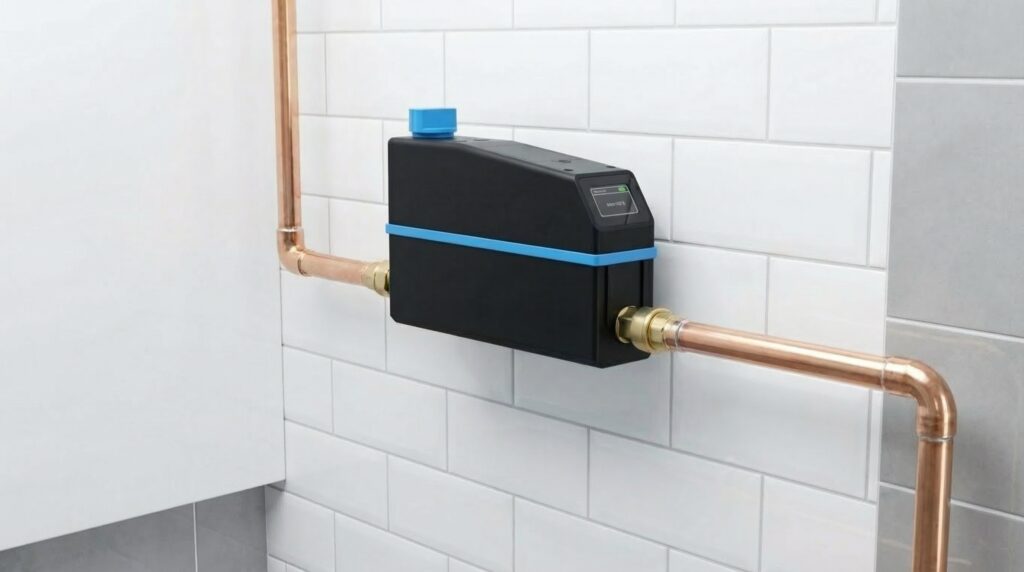
Smawatec is not just a passive meter; it is an active Flowstopper. Here is why it is the superior choice for your certification strategy:
- Surpassing Wat 03 (BREEAM): Smawatec does not just “sound an alarm” when a major leak is detected (as required for the first Wat 03 credit); it automatically shuts off the water. Its ability to detect “micro-leakage” and “abnormal flow duration” exceeds the baseline requirements for major leak detection, providing superior evidence for your BREEAM assessor.
- Data Granularity for LEED: The Smawatec dashboard provides precise, real-time flow data. This high-resolution data makes submitting your “Building-Level Water Metering” reports effortless and accurate, removing the administrative burden from your facility management team.
- The “Innovation” Factor: Both LEED and BREEAM have categories for “Innovation” or “Exemplary Performance.” Smawatec’s ability to remotely manage multi-site portfolios and its autonomous AI-driven learning of building consumption patterns can often be leveraged to argue for these innovation credits.
Conclusion
In the race for Platinum or Outstanding certification, hardware selection matters. You can install a standard meter and a separate alarm system, or you can install a Smawatec Flowstopper.
By choosing Smawatec, you aren’t just installing a device; you are installing a compliance engine that ticks the boxes for Monitoring (Wat 02), Leak Detection (Wat 03), and Water Efficiency (WE) simultaneously.